
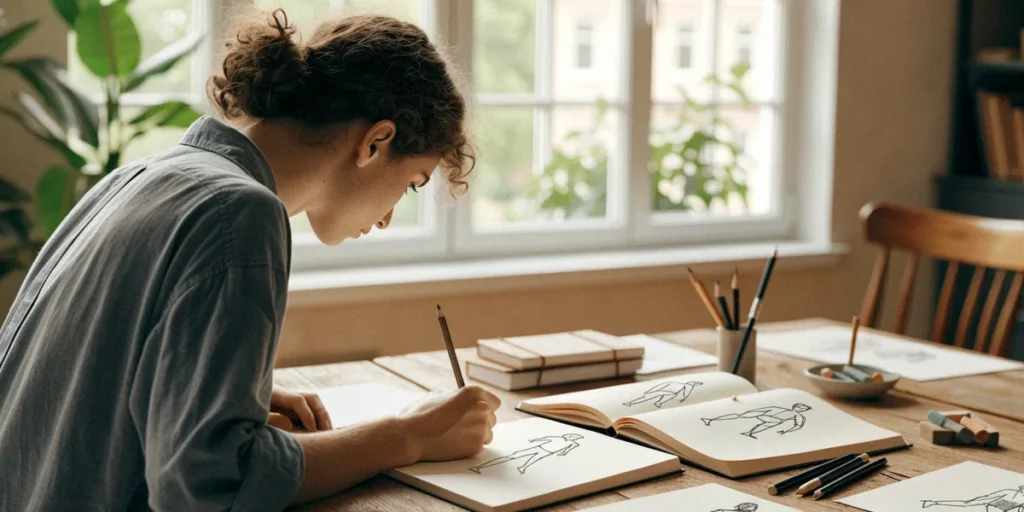
Gesture Drawing Exercises You Can Do in 10 Minutes
We know the feeling. It is 9 p.m. on a Tuesday, you just got home from a shift or a long commute, and your sketchbook is staring at you from across the room. You want to improve your figure drawing, but the idea of setting up a full life drawing session feels impossible. Here is the good news: ten focused minutes is enough to keep your skills moving forward. Our team has watched hundreds of students in Montreal art classes make real progress with nothing more than a timer, a pencil, and a handful of quick poses. Below are the exact exercises we recommend, ordered from warm-up to advanced, so you can start tonight.
Why 10-Minute Gesture Drawing Sessions Work
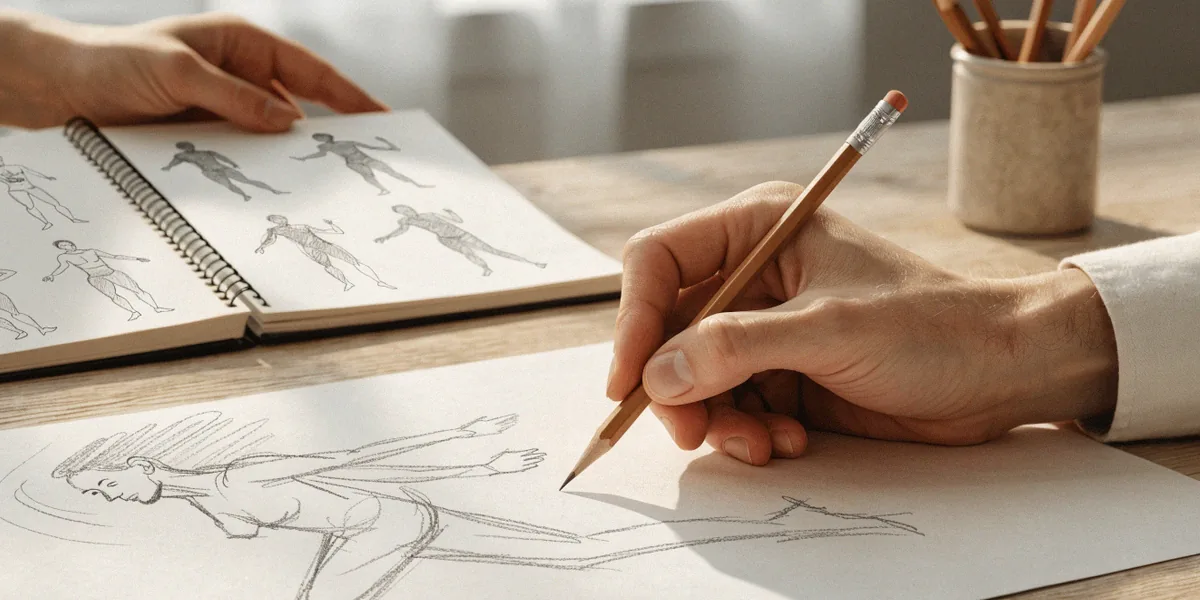
Short sessions are not a compromise. They are a training method. When you draw a pose in 30 seconds or two minutes, your brain cannot afford to fuss over eyelashes or shading. It has to make decisions fast, and those decisions are what build the instincts behind good figure drawing.
The Science of Quick Studies
Gesture drawing trains your eye to read a pose as a whole before your hand commits to a line. In the 30-second to 2-minute poses common in Montreal art classes, you are essentially rehearsing the same cognitive loop over and over: observe, simplify, commit. That repetition strengthens the neural pathways linking visual perception to motor output, which is why professional animators still do quick studies years into their careers. The speed forces prioritization, and prioritization is a skill you cannot learn from a slow, careful rendering.
How Consistency Beats Duration
Ten minutes every day will outperform a three-hour session once a month, every single time. Muscle memory is built through frequency, not marathon effort. If you draw 20 gestures today and then nothing for two weeks, your hand forgets the rhythm. If you draw 10 gestures daily, the rhythm becomes automatic. We tell our students to think of it like scales for a musician: short, boring, and absolutely essential.
Warm-Up: 30-Second Scribbles to Loosen Your Hand
Start every session with a rapid-fire warm-up. The goal here is not accuracy. The goal is to wake up your arm and stop drawing timidly.
Setting Up Your Timer
Use any timer app, or the built-in session tool on Line of Action, which lets you set pose duration and choose from categories like figure, hands, or animals. Set it to 30 seconds and do ten poses without stopping. No erasing, no second-guessing. When the timer beeps, move on immediately, even if the drawing is unfinished. The pressure is the point.
Focusing on Flow, Not Form
For each 30-second scribble, draw one continuous action line from the top of the figure to the bottom. Do not outline the body. Do not draw circles for heads. Just chase the energy of the pose. If the figure is lunging, your line should lunge. If the figure is curled up, your line should curl. This is the single fastest way to improve the readability of your gesture drawing.
Core Exercise: 2-Minute Gesture Drawings from Life or Video
Once your hand is loose, move to two-minute poses. This is the sweet spot where you have enough time to think about structure but not enough time to overwork the drawing.
Choosing Dynamic Poses
Draw from life whenever possible: a friend cooking, a family member reading, or a classmate stretching. When nobody is available, YouTube is a goldmine. Search for dance rehearsals, martial arts, or parkour footage and pause on interesting frames. This mirrors the kind of reference work done in animation training at Montreal studios like Ubisoft and Moment Factory, where artists constantly study motion from video to understand weight, timing, and follow-through.
Capturing Weight and Balance
In two minutes, ask yourself three questions for every pose:
- Where is the weight resting? Find the supporting foot, hip, or hand and anchor your drawing there first.
- Where is the center of gravity? Drop an imaginary vertical line from the pit of the neck and see where it lands.
- What is the line of action? Draw it before anything else, then build the body around it.
If your figure looks like it is floating, the weight is wrong. If it looks stiff, the line of action is probably too vertical.
Advanced Variation: 10-Second Extreme Poses
This is where things get uncomfortable, and that is exactly why it works. Ten-second poses strip away everything except silhouette and energy.
Using Silhouette to Check Readability
Sources like Quickposes are perfect for this drill. Set the timer to 10 seconds and fill the page with solid shapes rather than outlines. If you squint at your page and cannot tell what each figure is doing, the silhouette failed. Animators care deeply about this because a pose that does not read in silhouette will not read in motion either.
Avoiding Overworking Lines
At ten seconds, you have time for roughly three to five marks. That is it. Do not go back over a line to “fix” it. Draw the next pose instead. This habit builds the confidence you need for animation portfolio reviews, where reviewers want to see decisive, energetic drawings, not hesitant ones covered in eraser marks.
Incorporating Gesture into Your Animation Training Routine
The exercises only pay off if they become part of your week. Here is how we structure it for students juggling school, work, and everything else.
Building a Daily Habit
Attach your ten minutes to something you already do. Right after your morning coffee. Right before bed. During your lunch break. A simple weekly structure looks like this:
- Monday to Friday: 10 minutes of 30-second and 2-minute gestures.
- Saturday: 20 minutes of 10-second extreme poses plus one 5-minute study.
- Sunday: rest, or flip through the week’s pages and note what improved.
If you want external structure, local Montreal art classes and online communities like the r/learnart subreddit or the Line of Action forums are great places to post work and get feedback.
Tracking Progress with a Sketchbook
Date every page. Once a month, flip back through and compare. You will notice fewer stray lines, stronger action lines, and faster decision-making. That visible progress is what keeps the habit alive when motivation dips.
Tools and Resources for Montreal Artists
You do not need expensive supplies to practice gesture drawing. In fact, cheaper materials often help, because you are less afraid to make bold marks.
Budget-Friendly Supplies
We recommend newsprint pads, which cost a fraction of good drawing paper, plus vine charcoal or a soft graphite stick. A kneaded eraser is optional. Total cost for a month of practice is usually under $25 at any art supply shop in the city.
Local Life Drawing Meetups
For live practice, the Montreal Museum of Fine Arts runs occasional figure drawing sessions tied to its collections, and there are regular drop-in life drawing meetups across the Plateau and Mile End. These are excellent for applying your 10-minute habits to longer poses in a room full of other artists.
FAQ
How often should I practice gesture drawing?
Daily if possible, even for just ten minutes. Frequency matters more than session length when you are building muscle memory and observation speed.
Do I need a live model to practice?
No. Reference photo sites like Line of Action and Quickposes are excellent, and YouTube videos of dancers or athletes work well for studying motion. Live sessions at places like the Montreal Museum of Fine Arts are a great supplement, not a requirement.
What is the difference between gesture drawing and figure drawing?
Gesture drawing captures the action, energy, and flow of a pose in a short time. Figure drawing is a broader term that includes gesture but also longer studies of anatomy, proportion, and rendering.
How long should each pose be?
Start with 30-second poses to warm up, move to 2-minute poses for structure, and finish with 10-second extreme poses to sharpen silhouette and confidence.
Will this actually help my animation portfolio?
Yes. Studios like Ubisoft and Moment Factory look for strong gesture and pose readability in portfolios. Ten minutes a day builds exactly those skills.
Ten minutes a day is not a shortcut. It is the habit that separates artists who talk about improving from artists who actually do. Grab a timer, open Line of Action or Quickposes, and draw your first ten poses tonight. Your gesture drawing, and eventually your animation portfolio, will thank you.