
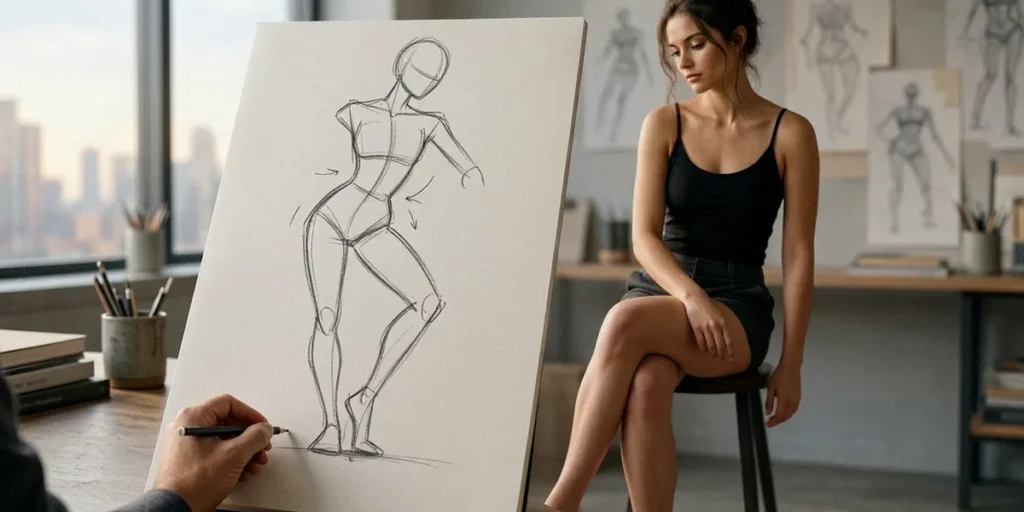
Figure Drawing for Animation: Mastering Line of Action, Weight, and Balance
You flip through your sketchbook and something feels off. The poses are technically accurate — proportions check out, hands have five fingers, heads sit on shoulders — but nothing moves. Every figure looks like it’s waiting for a bus, frozen mid-thought instead of mid-action. So what actually separates dynamic animation drawings from static ones? In our experience teaching and drawing in Montreal, the answer comes down to three fundamentals: line of action, weight, and balance. Get those right, and even a rough 30-second gesture will read with more life than a polished render that ignores them.
Why Figure Drawing Still Matters in Montreal Animation

Montreal has grown into one of the most concentrated animation hubs in North America. Ubisoft, Sony Pictures Imageworks, and the National Film Board of Canada all operate here, alongside dozens of smaller studios, game developers, and VFX houses. That density means competition is real — and the artists who get hired are usually the ones who can draw. Not just render, not just rig, but draw. Studios need people who understand how a body moves through space before they ever touch a timeline.
The National Film Board of Canada has a particularly rich animation history, and its legacy still inspires local artists to push gesture and storytelling over technical polish. When we talk to recruiters and leads around the city, the same theme comes up: they want portfolios that show thinking, not just finishing.
The Montreal Animation Scene: Studios and Opportunities
From feature animation to indie games to NFB shorts, Montreal’s production ecosystem is unusually diverse. Ubisoft’s Montreal studios employ hundreds of animators across franchises, Sony Pictures Imageworks handles high-end feature work, and the NFB continues to fund experimental and auteur-driven animation. Smaller shops, advertising studios, and mobile game developers round out the market. What this means for you: there’s demand, but it rewards foundational skill. A strong gesture drawing habit will serve you across every one of these environments.
What Recruiters Look for in an Art Portfolio
When reviewers open a portfolio, they’re scanning for a few specific signals. We’ve seen this criteria repeated across Canadian animation programs and studio hiring pipelines:
- Clear line of action in every pose — even in fully rendered pieces
- Believable weight distribution and center of gravity
- Gesture sheets showing range and quick thinking
- Animation tests or pose-to-pose studies, not just stills
- Evidence of growth — before/after studies, sketchbook pages, iterations
Polish matters, but it comes second. A clean gesture drawing with a strong spine will beat a stiff, over-rendered illustration almost every time.
The Line of Action: Your Drawing’s Backbone
The line of action is the imaginary curve that runs through a figure’s pose from head to toe (or from the core outward). It captures energy, direction, and intent in a single stroke. Animators at studios like Sony Pictures Imageworks routinely block in this line before adding any anatomy, because it dictates how the entire pose will read at a glance. If the line is weak, no amount of detail will save the drawing.
Finding the Line in Quick Gesture Drawings
In a 30-second gesture, your only job is to find the line. Not the contour, not the fingers, not the shading — the line. Start at the head or the hip and draw one sweeping stroke that describes the flow of the pose. Everything else hangs off that spine. When the line is clear, the pose reads instantly, even as a scribble.
Common Mistakes: Overworking the Contour
The most frequent habit we see in student work is outlining the silhouette before establishing the gesture. This locks the pose into a shape before you’ve decided what the figure is doing. Contour is the last thing you should care about. If you find yourself carefully tracing an arm before you’ve drawn the spine, stop, erase, and start with the line again.
Exercises to Train Your Eye at Montreal Life Drawing Sessions
Life drawing sessions in Montreal, including the drop-in figure drawing at Studio Technique Montreal, are ideal for this. Try these drills:
- 30-second gestures — line of action only, no detail
- 2-minute gestures — line plus a simple shape for the torso and hips
- Blind contour drawings — trains observation without overthinking
- One-line drawings — never lift your pencil for the entire pose
Affordable drop-in sessions around the city make this easy to practice weekly without breaking your budget.
Weight and Balance: Making Poses Believable
Weight is what sells mass. Balance is what sells intent. Together they tell the viewer whether a character is pushing, resting, falling, or about to move. Figure drawing courses in Canada often drill these principles through sustained poses and force-based studies, because they’re almost impossible to fake. A figure that ignores gravity looks like a sticker on a page.
Center of Gravity and Support
Every believable pose has a center of gravity that sits over its support — usually the feet, sometimes a hand, a prop, or a wall. When the center of gravity drifts outside the support base, the character is either falling or in motion. Understanding this lets you draw a standing figure that feels grounded instead of floating.
Showing Tension and Relaxation Through Weight
Compare a figure leaning on a railing versus one standing at attention. The leaning figure’s weight is distributed through the arm and hip; the standing figure’s weight sits vertically through the spine. Tension shows up as compression — bent joints, stretched muscles, angled shoulders. Relaxation shows up as sag — curved spines, dropped hips, loose limbs. Both are weight problems, not detail problems.
Using Props and Environment to Reinforce Balance
A character holding a heavy bag, leaning on a cane, or resting against a wall gives you free information about weight. Props act as visual anchors. When we plan poses for animation, we often sketch the prop first, then build the figure around it — it forces the pose to be honest about balance.
How to Practice: From Life Drawing to Animation Poses
Consistent practice beats sporadic intensity. A short daily session will outperform a marathon weekend every time. The goal isn’t perfect drawings — it’s building the muscle memory to see line, weight, and balance before you start rendering.
Building a Daily Sketching Habit
Set a realistic target: 15 to 30 minutes a day. Fill a page with gestures. Rotate between short poses (30 seconds) and longer studies (5–10 minutes). Keep a dedicated sketchbook just for figure work so you can flip back and see progress.
Applying Figure Drawing to Character Animation
Once gestures feel natural, apply them to animation exercises. Take a simple action — a jump, a push, a turn — and draw the key poses using only line of action first. Then layer in weight and balance. This is exactly how professional animators plan shots before touching a rig.
Recommended Resources and Local Workshops
Studio Technique Montreal offers figure drawing sessions and animation courses that focus specifically on gesture and weight, which makes it a strong local starting point. Beyond that, we recommend studying classic animation texts, following gesture-focused artists online, and attending any drop-in life drawing session you can find around the city.
Bringing It All Together in Your Art Portfolio
Your portfolio is a curated argument for your skills. If line of action, weight, and balance are what studios want, those should be visible in nearly every piece. Animation courses in Canada often review portfolios with exactly these criteria in mind, so it pays to design yours around them.
Selecting Pieces That Show Dynamic Poses
Choose work where the figure is clearly doing something — twisting, reaching, pushing, falling. Static standing poses are fine as supporting pieces, but the bulk of your portfolio should show motion and intent.
Annotating Your Process for Reviewers
Short captions or process sheets showing your gesture sketch next to the final render are gold. They demonstrate that you understand why the pose works, not just that you can execute it. Reviewers love seeing the thinking behind the drawing.
Common Portfolio Pitfalls to Avoid
- Too many polished renders with weak underlying poses
- No gesture sheets or sketchbook pages
- Repetitive poses that all face the same direction
- No animation tests or pose-to-pose studies
- Missing evidence of growth or iteration
Fix those, and your portfolio will read as the work of someone who understands the fundamentals — which is exactly what hiring teams are scanning for.
FAQ
Do I need formal training to work in Montreal animation?
Not strictly, but you do need demonstrable skill. Most working animators in Montreal came through a program, a mentorship, or years of self-directed practice. What matters is the portfolio and whether it shows strong figure drawing fundamentals.
How often should I attend life drawing sessions?
Weekly is a good baseline. If you can manage twice a week, even better. The key is consistency — regular short sessions build gesture skills faster than occasional long ones.
What’s the difference between gesture drawing and figure drawing?
Gesture drawing focuses on the line of action and overall movement of a pose, usually in under a minute. Figure drawing is broader and includes longer studies of anatomy, proportion, weight, and rendering.
Can I build a portfolio without animation software experience?
Yes. Many strong portfolios are built entirely from pencil and paper. That said, adding a few simple animation tests — even rough ones — shows reviewers you can apply your drawing skills to motion.
Where can I find affordable figure drawing in Montreal?
Drop-in sessions at places like Studio Technique Montreal are a solid option, and there are several other community-run life drawing nights across the city. Most are pay-per-session and open to all skill levels.
Figure drawing isn’t a phase you graduate out of — it’s the practice that keeps your animation sharp for the length of your career. Line of action, weight, and balance are the foundation of every compelling character animation, whether you’re working at Ubisoft, the NFB, or on your own short film. Keep filling sketchbooks, keep attending life drawing, and keep studying how real bodies move. Share your sketches with us, or join our next Montreal meetup — we’d love to see what you’re working on.