
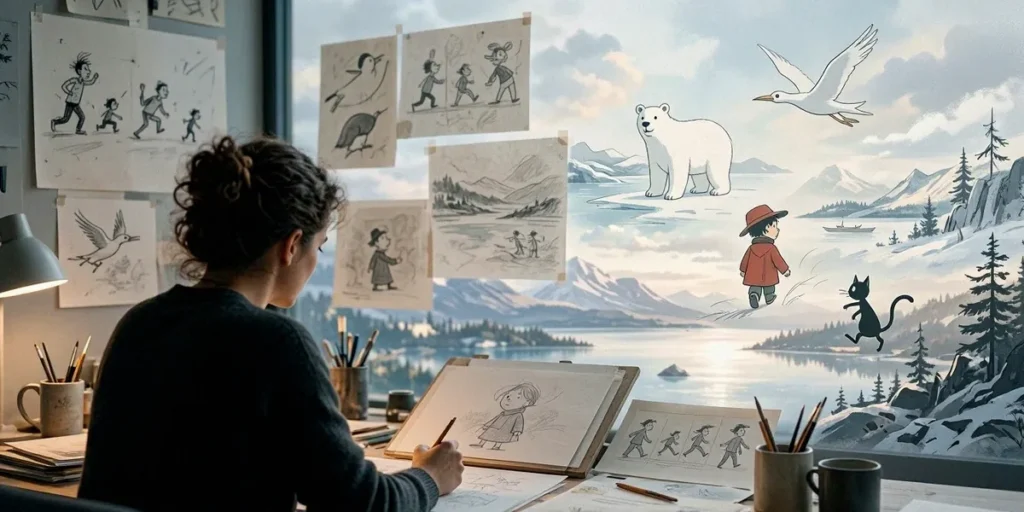
How the National Film Board Shaped Canadian Animation
Picture two neighbours, played by two ordinary men, stepping outside their homes and trading punches in slow, deliberate increments until their aggression destroys them both. Norman McLaren’s Neighbours (1952) was shot frame by frame, with live actors manipulated like puppets, and it won an Oscar for Best Documentary Short. That single film announced something bigger than one director’s talent: it proved that a government-funded studio in Canada could produce animation that rivalled anything in the world. The National Film Board of Canada (NFB) became the bedrock of Canadian animation, and its influence still runs through every studio, classroom, and portfolio in Montreal.
The Birth of the NFB and Its Animation Unit
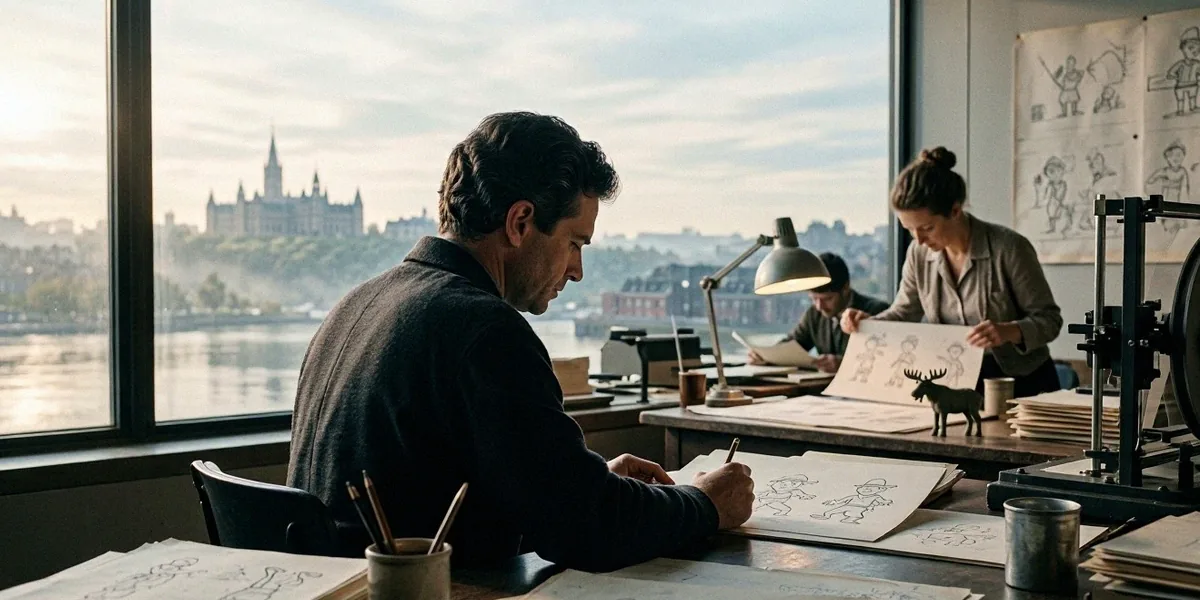
The NFB was founded in 1939 by John Grierson, a Scottish documentary filmmaker who had been invited by the Canadian government to study how film could serve national communication. He stayed to build the institution. By 1941, Norman McLaren had launched the Board’s animation unit, and with it came something rare: a government-funded haven for experimental film, where artists were paid to push technique rather than chase box office returns.
John Grierson’s Vision for a National Film Board
Grierson believed film should document real Canadian life and, just as importantly, employ the country’s artists. The NFB opened in Ottawa and later moved its headquarters to Montreal, giving animators a stable salary, access to equipment, and the freedom to fail. That combination is unusual anywhere in the world, and it is the reason so much animation history was written in Canada rather than simply imported into it.
Norman McLaren and the First Animation Unit
McLaren arrived from Scotland and quickly assembled a small team of animators. They worked in a converted office space with cameras bolted to animation stands, drawing directly onto film stock and scratching images frame by frame. The unit’s output was small but relentlessly inventive, and its reputation drew other artists to Canada throughout the following decades.
Norman McLaren: The Experimental Genius
McLaren’s Neighbours won the Academy Award in 1952, making him one of the most celebrated animators of his generation. But the Oscar was a byproduct of something more important: a working method that treated the film strip itself as a canvas. His techniques, including pixilation and optical printing, set a global benchmark for what animation could be.
Oscar-Winning ‘Neighbours’ and Pixilation
Pixilation is the technique of animating live human beings frame by frame, so their movements become jerky and stylized. In Neighbours, McLaren used it to turn a simple dispute over a flower into an anti-war parable. The method required enormous patience, and it demonstrated that animation did not have to look like drawings moving on paper.
Direct Animation and Optical Printing Techniques
McLaren often worked without a camera at all, painting and scratching directly onto clear film stock, then running it through an optical printer to combine layers and manipulate colour. He also experimented with synthetic sound, drawing waveforms onto the soundtrack area of the film so images generated their own music. Animators around the world copied these approaches, and many of them are still taught in animation courses Canada-wide.
The NFB’s Golden Era: 1960s-1980s
The decades after McLaren’s breakthrough turned the NFB into a training ground for a remarkable generation of artists. Caroline Leaf, Frédéric Back, and Ishu Patel each developed signature techniques under the Board’s roof, and their films collected awards internationally. This is the period when Canada’s reputation as an animation superpower became permanent.
Caroline Leaf and Paint-on-Glass Animation
Caroline Leaf developed a method of painting with ink and oil on a sheet of glass, then manipulating the wet paint with her fingers while shooting one frame at a time. The result was fluid, organic movement that looked like nothing else being made. Her NFB films, including The Street and Two Sisters, remain reference points for animators interested in texture and gesture.
Frédéric Back and ‘The Man Who Planted Trees’
Frédéric Back, a French-born artist working in Montreal, spent years on The Man Who Planted Trees, an adaptation of Jean Giono’s story about a shepherd who reforests a barren valley. The film won the Academy Award for Best Animated Short in 1988 and is widely considered one of the finest animated films ever made. Back’s delicate charcoal and coloured-pencil style required thousands of drawings, and it proved that environmental themes could carry a mainstream audience.
Ishu Patel and Backlit Animation
Ishu Patel pushed in a different direction, placing cut-out shapes and gels on a backlit glass surface and photographing them from above. Films like Perspectives and Paradise used light itself as a material, producing glowing, jewel-like images. His work expanded the visual vocabulary of the studio and gave younger animators permission to treat light and colour as primary tools.
How the NFB Shaped Animation Montreal
When the NFB moved its headquarters to Montreal, the city gained an anchor institution. Animators who trained at the Board stayed in the city, taught at local schools, and founded studios. Over time, Montreal developed the density of talent and infrastructure that makes it one of the most active animation cities in North America.
Montreal as an Animation Hub
Montreal now hosts a dense cluster of production companies, visual effects houses, and independent animators, along with festivals and screening series that keep the community connected. The NFB’s Montreal headquarters remains a working studio and a symbolic centre, and its archives are a resource for anyone researching Canadian animation.
Influence on Local Studios and Schools
The National Animation and Design Centre, founded in Montreal, trained a generation of artists in the technical and creative skills that the NFB had pioneered. Local universities and colleges built animation programs that borrowed directly from the Board’s emphasis on experimentation. The independent scene, meanwhile, inherited the idea that a short film can be a personal artistic statement rather than a commercial calling card.
The NFB’s Legacy in Modern Canadian Animation
The Board did not stop innovating after the golden era. It continued to fund short films, support emerging directors, and take chances on techniques that commercial studios would not touch. That ongoing commitment is why the NFB still matters to anyone studying character animation or building an art portfolio today.
Cordell Barker and Contemporary Shorts
Cordell Barker’s The Cat Came Back (1988) is one of the NFB’s most beloved films, a frantic, hand-drawn comedy about a man whose cat refuses to leave. It was nominated for an Academy Award and became a staple of Canadian childhoods through television broadcasts. Barker’s later films, including Strange Invaders, continued the tradition of sharp, character-driven storytelling backed by public funding.
Impact on Animation Education and Portfolios
Animation schools across Canada use NFB films as teaching material because they demonstrate craft without relying on spectacle. Students study McLaren’s timing, Leaf’s texture, and Back’s patience. The Board’s catalogue also functions as a portfolio benchmark: it shows what a short film can achieve when the artist controls every frame.
What We Can Learn from the NFB Today
We return to the NFB’s model often when we think about our own work. The Board’s history suggests that artistic risk and stable support are not opposites, and that the best portfolios are built by animators who develop a recognizable voice rather than imitating whatever is trending.
Public Funding and Artistic Risk
The NFB’s structure allowed animators to spend years on a single film without commercial pressure. That patience produced The Man Who Planted Trees, Neighbours, and countless other works that would never have survived a market-driven greenlight process. The lesson is not that every animator needs a government grant, but that protecting time for experimentation is what separates memorable work from disposable work.
Building Your Portfolio with NFB Inspiration
When we advise students on portfolio development, we suggest studying the NFB catalogue with a specific question in mind: what is this film doing that I could adapt to my own strengths? A few practical starting points:
- Pick three NFB shorts and identify the single technique each one depends on, then try a short exercise using that technique.
- Study how McLaren and Back handle timing, since pacing is what makes limited animation feel alive.
- Include at least one personal short film in your portfolio, not just assignments or client work.
- Document your process, including sketches and tests, because schools and studios want to see how you think.
- Watch contemporary NFB releases to see how the Board’s experimental tradition continues today.
The NFB’s spirit of experimentation and community is still what draws us to animation in Montreal. A government studio that trusted artists with public money, and artists who repaid that trust with Oscar-winning work, created a culture we are all still working inside.
FAQ
What is the National Film Board of Canada known for?
The NFB is Canada’s public film producer and distributor, founded in 1939. It is best known for documentary and animated short films, including Norman McLaren’s Neighbours and Frédéric Back’s The Man Who Planted Trees, and for pioneering experimental animation techniques.
Why did the NFB move its headquarters to Montreal?
The NFB relocated its main operations to Montreal in the 1950s, consolidating production in a city with a strong artistic community. The Montreal headquarters remains its creative centre and a major hub for animation production in Canada.
Which NFB films won Academy Awards?
Norman McLaren’s Neighbours won in 1952, and Frédéric Back’s The Man Who Planted Trees won Best Animated Short in 1988. Cordell Barker’s The Cat Came Back was nominated in 1989, and many other NFB productions have received nominations over the decades.
How can the NFB influence my art portfolio?
Studying NFB films helps you understand timing, texture, and storytelling economy. We recommend analysing a handful of shorts, identifying the techniques behind them, and applying those lessons to a personal short film that shows your individual voice.
Does the NFB still produce animation today?
Yes. The NFB continues to fund and produce animated shorts, supporting both established directors and emerging voices, and its films remain widely used in animation education across Canada.