
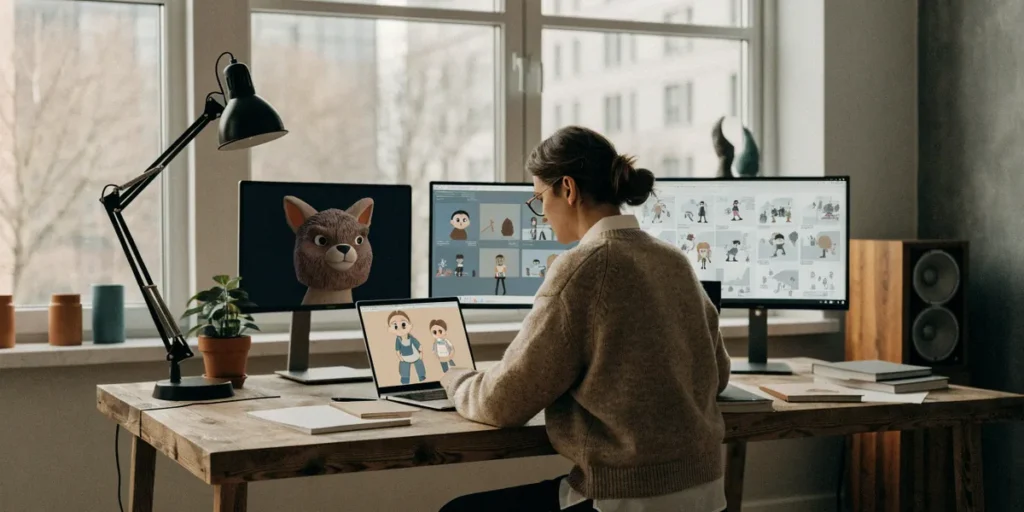
Building an Animation Portfolio for Canadian Studios: A Montreal Perspective
Every week, we meet aspiring animators who show us a portfolio stuffed with fifty finished character illustrations — and almost no life drawing. They’ve spent months polishing digital paintings of their OCs, yet when we ask them to sketch a figure in motion in under two minutes, they freeze. It’s the single most common mistake we see in Montreal, and it quietly costs people jobs. Canadian studios don’t hire portfolios; they hire potential, and that potential is judged largely by how well you understand the human figure in motion. If you’re aiming at Nelvana, Atomic Cartoons, or a smaller Montreal shop, a strategic portfolio built on figure drawing fundamentals will take you much further than a gallery of finished art.
Why Canadian Studios Value a Strong Foundation in Figure Drawing
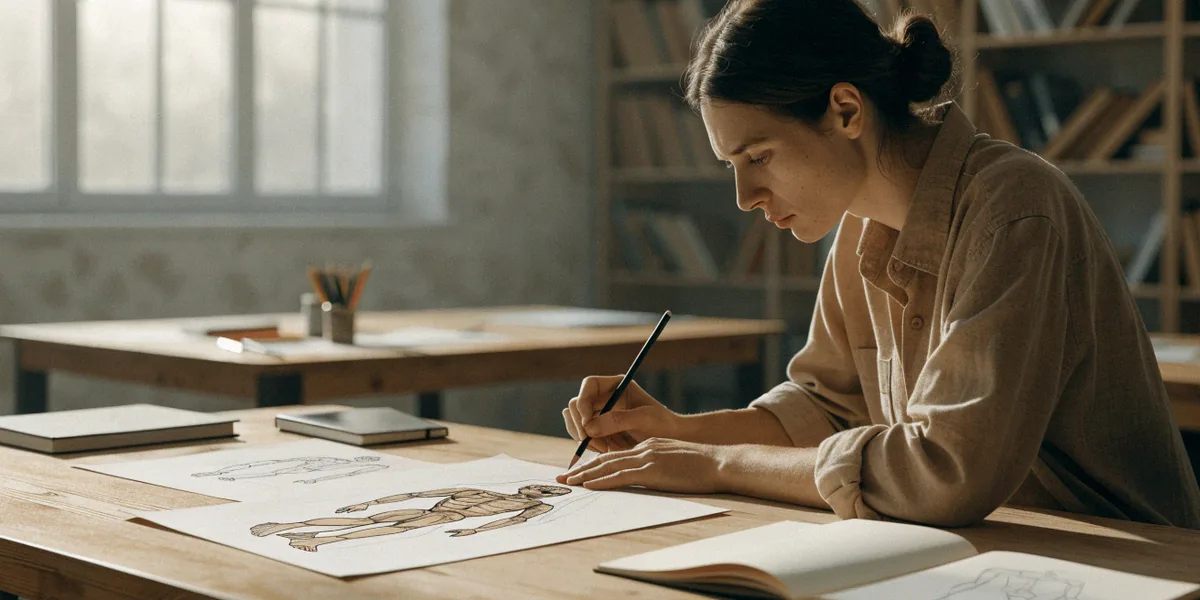
Animation is acting through drawing, and acting requires believable bodies. Recruiters at Nelvana, Atomic Cartoons, and Bardel Entertainment have all said variations of the same thing in portfolio reviews and talks: they can teach you software, pipeline, and house style, but they can’t teach you to see. Solid figure drawing proves you can observe weight, balance, and rhythm — the raw materials of any convincing character performance. When a character walks, jumps, or slumps in defeat, the animator is really drawing a figure from life, just filtered through a design.
This is why gesture drawing sits at the centre of it. A gesture sketch captures the essence of a pose — the line of action, the tilt of the hips, the thrust of the chest — in seconds. Animators who practice gesture daily produce poses with life and appeal; those who skip it produce stiff, mannequin-like animation that supervisors have to fix in dailies.
The Role of Gesture Drawing in Animation
In a production pipeline, you rarely have hours to design a pose. You have minutes, sometimes seconds, to rough out a key or a breakdown. Gesture drawing trains exactly that speed of decision-making. It also builds your mental library: after hundreds of sessions, you start to feel where weight shifts and how momentum carries through a body. That intuition is what separates an appealing walk cycle from a mechanical one.
How Montreal Art Classes Build These Skills
Montreal has an unusually rich ecosystem for this. Local art classes — whether at Concordia, Dawson College, or independent ateliers — typically combine timed life drawing with longer sustained poses, so you develop both speed and structural accuracy. Our own figure drawing sessions at Studio Technique Montreal follow the same logic: short gestures to warm up the eye, then longer studies to build anatomy and form. Students who attend consistently for a few months see their animation poses improve before they’ve touched a single frame.
What Canadian Studios Look for in an Animation Portfolio
Studios like Guru Studio, Pipeline Studios, and Jam Filled Entertainment are not looking for a finished artist. They’re looking for someone with a point of view. Yes, they want clean construction and confident linework, but they also want to see personality, humour, and storytelling instinct. A technically perfect drawing of a generic character is less interesting to them than a rough sketch of a character who is clearly thinking about something.
Most recruiters spend under two minutes on a first pass. That means your strongest work needs to be visible immediately, and your portfolio needs to communicate range without becoming a slog.
Key Portfolio Pieces That Get Noticed
- Life drawings — both short gesture poses and longer sustained studies, ideally from a real model.
- Gesture sketches — pages of them, showing you can capture motion quickly and consistently.
- Character designs — with expression sheets and turnarounds, proving you can think in three dimensions.
- Animation tests — a walk cycle, a jump, a short acting piece. Even rough 2D or 3D tests show you understand timing and spacing.
- Story beats or boards — a short sequence that shows you can stage an idea, not just draw a pose.
Common Mistakes to Avoid
The biggest one is padding. Twenty mediocre pieces dilute five strong ones. We also see portfolios that are all finished digital paintings with no process work — recruiters want to see your roughs, your construction lines, your thinking. Another frequent issue is a lack of variety: if every character is the same slim, stylized young adult, studios can’t tell whether you can handle a preschool show, an action series, or a comedy. Finally, avoid copying existing studio styles too closely. It signals you can imitate, not originate.
How to Structure Your Portfolio for Maximum Impact
Curation is a skill in itself. Think of your portfolio as a short film: it needs a strong opening, a clear middle, and a memorable ending. Lead with your single best piece — usually a confident life drawing or a striking character design — and close with something equally strong. The middle is where you demonstrate range.
Ordering Your Work for Flow
Group pieces by skill rather than chronology. A common structure that works well:
- Hero piece (best single drawing)
- Life drawing and gesture section
- Character design and expression work
- Animation tests and motion studies
- Story or board sequence
- Closing hero piece
This lets a reviewer evaluate you category by category without hunting through the document. Keep the whole thing to 15–25 pieces. Fewer, stronger, better.
Digital vs. Physical Portfolios
Digital is the standard — a clean PDF under 15 MB, or a simple website with no autoplay video and no password friction. But don’t underestimate a physical sketchbook. At events like the Ottawa International Animation Festival (OIAF), recruiters and artists genuinely enjoy flipping through a real book. It shows your daily practice and your thought process in a way a polished PDF can’t. Bring both.
Training Pathways in Montreal to Build Your Portfolio
Montreal is one of the best cities in North America to train for animation. Concordia University’s Mel Hoppenheim School of Cinema and Dawson College’s Professional Theatre and 3D Animation programs both feed directly into the local industry. Independent ateliers and drop-in life drawing sessions — including those at the Montreal Museum of Fine Arts and various neighbourhood studios — give you affordable weekly practice outside of formal schooling.
Our Approach at Studio Technique Montreal
At Studio Technique Montreal, we build training around the assumption that figure drawing and animation are the same discipline practiced at different speeds. Our figure drawing classes emphasize gesture, construction, and anatomy in a structured progression, while our animation training focuses on timing, spacing, and acting. Students work from live models regularly, and we push them to apply what they learn in life drawing directly to their animation tests. The goal isn’t just a better portfolio — it’s a sustainable practice you can carry into a studio job.
Supplementing with Workshops and Life Drawing
Formal classes are the backbone, but workshops and open life drawing sessions fill the gaps. A weekend workshop on animal locomotion or a figure drawing intensive can unlock something a semester-long course doesn’t. We recommend at least one open life drawing session per week, on top of your regular coursework, to keep your eye sharp.
Tailoring Your Portfolio to Different Canadian Studios
Not all Canadian studios want the same thing. Cartoon Network Canada (Corus) leans comedic and character-driven. Studios focused on preschool content want clear, appealing, simple shapes. Action and VFX-adjacent shops want strong anatomy and dynamic posing. Sending the same portfolio to all of them is a missed opportunity.
Researching Studio Styles and Reels
Before you apply, watch the studio’s recent reel. If their last three shows are preschool, lead with your cleanest, most appealing character work. If they’ve just delivered an action series, front-load your dynamic gesture drawings and animation tests. Adjust the order, not the content — never fabricate work you don’t have.
Networking and Feedback Opportunities
Events like TAAFI in Toronto and OIAF in Ottawa are worth the trip. Portfolio reviews there give you direct feedback from working professionals, and the informal conversations at bars and after-parties often lead to referrals. Montreal’s own animation community is small and friendly — a good impression at a local screening can travel further than a cold email.
FAQ
How many pieces should an animation portfolio have?
Aim for 15 to 25 strong pieces. Quality beats quantity every time. If you have ten excellent drawings and thirty average ones, submit the ten.
Do I need formal art school to get hired in Montreal?
No, but you need structured training. Many working animators came through Concordia or Dawson, while others trained at independent schools like Studio Technique Montreal or through consistent life drawing practice. What matters is the work.
How important is gesture drawing compared to finished illustrations?
For animation, gesture drawing is more important. It demonstrates how you think about motion, weight, and posing — the core skills of the job. Finished illustrations are a bonus, not a substitute.
Should my portfolio be digital or printed?
Digital is standard for applications. Bring a printed sketchbook to in-person events like OIAF, because it shows your daily practice and process in a way a PDF can’t.
How often should I update my portfolio?
Every few months, or whenever your work meaningfully improves. A portfolio is a living document — treat it like a reel and refresh it regularly.
Building an animation portfolio is not a one-time project. It’s an iterative process that rewards consistent practice, honest feedback, and a genuine love of drawing people in motion. Start with figure drawing, keep a sketchbook, attend life drawing sessions, and let your portfolio grow alongside your skills. The studios will notice.