
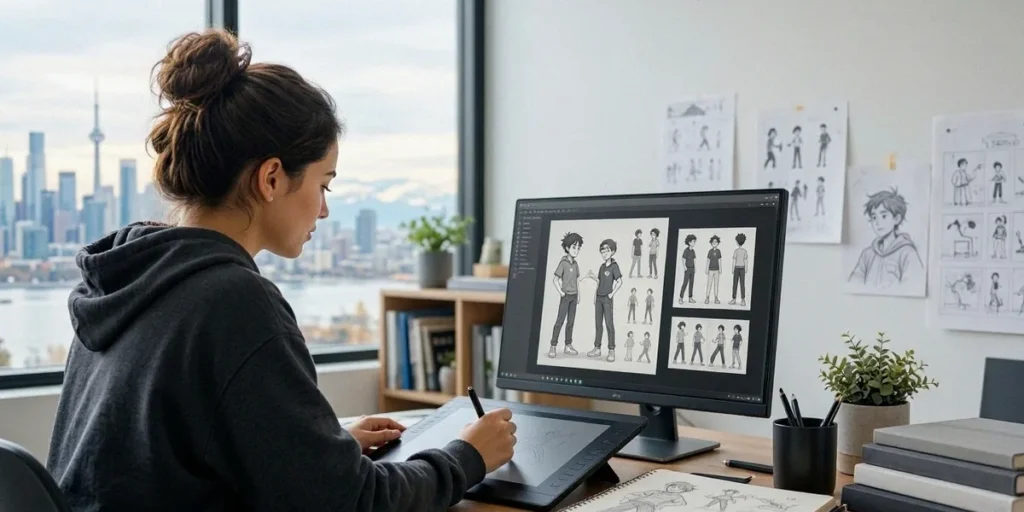
Building an Animation Portfolio for Canadian College Applications
We still remember the night it hit us. One of our students spread a year’s worth of drawings across a studio table here in Montreal, looked at the pile, and said, “So… which ones do I actually send?” That moment—half terror, half excitement—is when most of us realize a portfolio isn’t just a folder of drawings. It’s a story about who we are as artists, told in 10 to 15 pages. If you’re applying to animation programs in Canada, this guide walks you through what schools want, how to build the work, and where in Montreal you can grow fast enough to make it happen.
Understanding What Canadian Animation Programs Expect
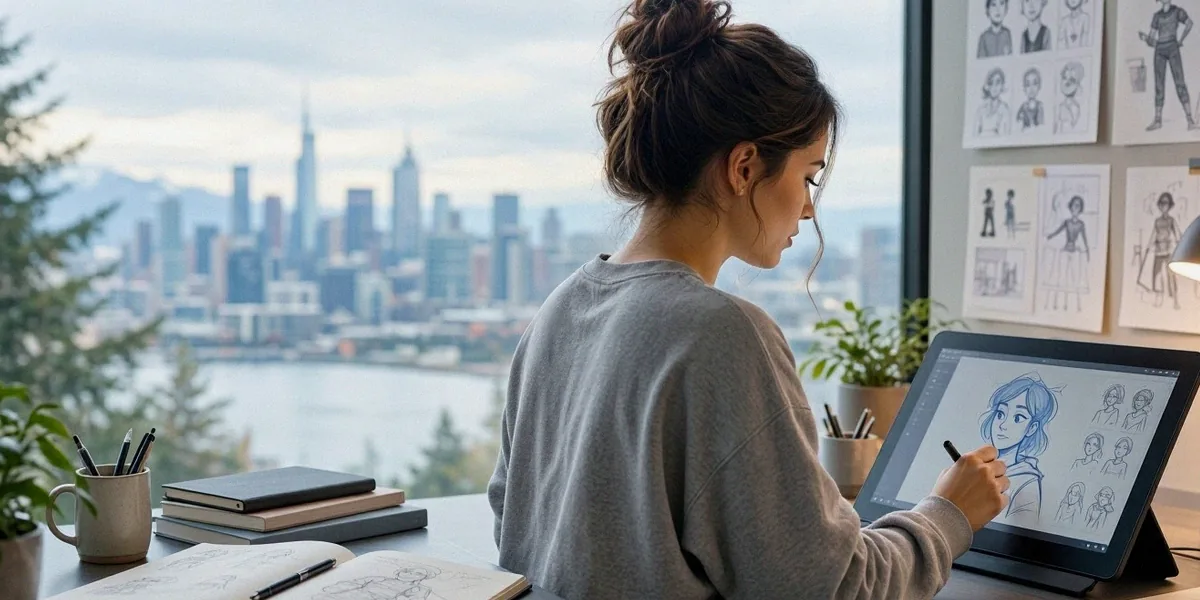
The first thing we tell every applicant: Canadian animation schools are not looking for finished, polished productions. They’re looking for evidence that you can see, think, and draw. Admissions committees want to know whether you have the foundation to survive four years of intense training—not whether you’ve already made a short film. That distinction changes everything about how you select work.
Sheridan College’s Portfolio Criteria
Sheridan College in Oakville, Ontario, is the benchmark most Canadian animation applicants measure themselves against, and its Bachelor of Animation portfolio is famously demanding. Sheridan typically asks for a mix of observational drawing, character work, and a personal piece, plus a sketchbook submission. What matters most is drawing from life: hands, feet, figures in motion, perspective studies of real spaces. Sheridan reviewers can tell within seconds whether a drawing came from observation or from imagination, and they weight the observational work heavily. Read the current portfolio requirements on Sheridan’s website carefully—the format changes slightly year to year, and missing a required category is one of the fastest ways to get filtered out.
Seneca College and Concordia University: What Sets Them Apart
Seneca College’s Animation program (in Toronto) tends to place more emphasis on digital workflow and storytelling, so a few strong digital pieces can carry more weight there. Concordia University’s Mel Hoppenheim School of Cinema in Montreal approaches animation from a fine-arts and film perspective—Concordia’s Faculty of Fine Arts portfolio review often rewards conceptual risk-taking and personal voice over technical slickness. In practice, that means the same portfolio won’t score identically at all three schools. We recommend building one core portfolio, then adjusting the emphasis for each application.
The Role of Sketchbooks in Applications
Almost every Canadian program asks for sketchbook pages, and this is where many applicants accidentally sabotage themselves. Do not clean up your sketchbook before scanning it. Schools want to see thinking: rough gestures, corrections, notes in the margins, studies of the same hand drawn five different ways. A sketchbook full of finished, polished drawings reads as staged. A messy, honest one reads as a working artist.
The Core Pillars: Figure Drawing and Character Animation
If we had to reduce portfolio preparation to one sentence, it would be this: life drawing is the engine, and character animation is the destination. Every gesture you draw from a live model trains your eye to capture weight, rhythm, and intention—the exact skills you’ll use later to make a character feel alive on screen.
Why Life Drawing Classes in Montreal Give You an Edge
Montreal is unusually rich in figure drawing resources. Atelier de Brésoles, a classical drawing and painting atelier in the city, runs sustained life drawing sessions grounded in traditional academic method—exactly the kind of rigorous observation that Sheridan and Concordia reviewers respond to. The advantage of training in Montreal is density: you can draw from life several times a week, from different models, in different studios, at a fraction of the cost of comparable cities. Repetition is what builds the eye, and Montreal makes repetition easy.
Capturing Gesture and Movement in Your Figure Drawings
When we review portfolios, the weakest drawings are almost always stiff. The fix is gesture drawing: 30-second to 2-minute poses where you chase the action line rather than the outline. Practice these until you can capture the tilt of a spine or the twist of a torso in three strokes. For portfolio submission, include a range—short gestures for energy, longer 20–30 minute studies for proportion and anatomy, and at least a few drawings where the model is in motion or foreshortened.
Translating Figure Drawing into Character Animation
Character animation is applied figure drawing. When you design a character, you’re making the same decisions you make in a life session: where is the weight, what’s the line of action, what does the pose say about the personality? We suggest pairing each character design with a small set of expression or pose studies so reviewers can see the connection. A character sheet with five distinct, believable poses will always beat one highly rendered static figure.
Structuring Your Portfolio: Variety, Story, and Technique
Most Canadian programs ask for roughly 10–15 pieces. The temptation is to fill that space with your best finished work. Resist it. Reviewers are scanning for range: can you draw from life, design from imagination, work traditionally, work digitally, and tell a story? Montreal’s animation studios—Ubisoft’s Montreal studio and Moment Factory, to name two—build entire worlds around visual storytelling, and schools are training you for that industry. Your portfolio should hint at narrative, even in a single image.
Balancing Traditional and Digital Artwork
A workable ratio for most applicants is roughly 60% traditional, 40% digital, adjusted for the school. Traditional work proves hand skills; digital work proves you can adapt to industry tools. If your digital work is weaker, don’t pad the portfolio with it—submit fewer digital pieces, done well.
Including Personal Projects and Sketchbook Pages
Personal projects show initiative. A short character turnaround, a small comic sequence, or a series of environment studies from your own neighbourhood all work. Include 3–5 sketchbook pages that show process, not just results.
The Importance of Titles and Descriptions
Every piece should have a short title and a one- or two-line description: what it is, whether it’s from life or imagination, and what you were exploring. This takes twenty minutes and dramatically improves how reviewers read your work.
Leveraging Montreal’s Art Scene for Portfolio Building
One of the real advantages of applying from Montreal is that your reference material is a bus ride away. We encourage every student to treat the city itself as a classroom.
Figure Drawing Sessions Around Montreal
Beyond Atelier de Brésoles, open life drawing sessions run regularly at venues like Café Cleopatra in the Quartier des Spectacles, along with sessions hosted by local art associations and university continuing-education programs. These drop-in sessions are cheap, social, and a great way to draw from a wide variety of models.
Workshops and Courses at Studio Technique
Studio Technique offers focused training in animation and figure drawing that fits neatly around a portfolio timeline—short, intensive workshops rather than multi-year commitments. For applicants who need to close a specific gap (gesture, anatomy, digital character work), this kind of targeted course is often more efficient than trying to self-teach.
Museums and Galleries for Reference and Inspiration
The Montreal Museum of Fine Arts is our first recommendation for master copy studies—drawing from sculpture and classical painting trains proportion faster than almost anything else. The Musée d’art contemporain de Montréal and the city’s many smaller galleries offer a different kind of fuel: contemporary approaches to character, colour, and narrative that can push your personal work somewhere less predictable.
Common Mistakes to Avoid in Your Animation Portfolio
We’ve reviewed enough portfolios to see the same handful of problems repeat every application cycle. All of them are fixable—usually in a few weeks, if you catch them early.
Overusing Fan Art and Copies
One or two fan pieces are fine if they’re genuinely strong. A portfolio that’s mostly existing characters tells reviewers you can copy, not create. Cap fan art at roughly 10–15% of your submission and make sure original characters dominate.
Neglecting Life Drawing and Observational Skills
This is the single most common reason strong-feeling portfolios get rejected. If your submission has no drawings from life—no figures, no hands, no real spaces—reviewers have no evidence of foundational skill. Fix it by adding five to eight observational pieces, even if they feel less “impressive” than your digital work.
Missing School-Specific Requirements
Sheridan, Seneca, and Concordia each publish specific portfolio prompts and format rules. Before submitting, build a simple checklist:
- Exact number of pieces required (and whether sketchbooks count separately)
- Required categories (observational drawing, character work, personal piece, etc.)
- File format, resolution, and naming conventions
- Submission platform and deadline
- Whether an interview or portfolio review is part of the process
Missing a single required category can disqualify an otherwise excellent portfolio. Check twice.
Final Steps: Review, Feedback, and Submission
The last month before deadlines should be about refinement, not creation. Stop starting new pieces and start getting eyes on what you have.
Seeking Feedback from Professionals
Ask instructors, working animators, and older students to review your portfolio as a whole—not piece by piece. You want to know what story the collection tells, what’s missing, and what’s weakest. Two or three honest reviews will improve your submission more than two more weeks of drawing.
Preparing Digital and Physical Portfolios
Most Canadian schools now use SlideRoom or a similar online platform. Scan or photograph work at high resolution, colour-correct it, and test how it looks on a screen you don’t own—reviewers may be viewing on a laptop or tablet. If a physical portfolio is requested for an interview, print at consistent sizes and mount pieces cleanly.
Interview and Portfolio Review Tips
If you’re invited to an interview, be ready to talk about three pieces in detail: why you made them, what you struggled with, and what you’d change. Reviewers aren’t testing whether you’re already a professional. They’re testing whether you’re teachable, self-aware, and genuinely interested in the craft.
FAQ
How many pieces should be in an animation portfolio for Canadian colleges?
Most programs ask for 10–15 finished pieces, plus sketchbook pages, which are often submitted separately. Always follow the specific school’s current requirements—Sheridan, Seneca, and Concordia each publish their own counts and categories.
Do I need life drawing experience to apply to animation programs in Canada?
Yes, effectively. Even schools that don’t state it explicitly expect observational drawing in your portfolio. Regular figure drawing sessions—like those at Atelier de Brésoles or drop-in sessions around Montreal—are the fastest way to build this skill.
Is digital art required, or can I apply with only traditional work?
Some programs accept mostly traditional portfolios, but a few strong digital pieces strengthen any application. A rough 60/40 traditional-to-digital split works well for most Canadian schools.
When should I start building my animation portfolio?
We recommend starting at least 12 months before your application deadline. That gives you time for weekly life drawing, a few Studio Technique workshops, and multiple rounds of feedback before submission.
Can fan art be included in an animation portfolio?
In small amounts, yes—but original characters and observational work should dominate. Reviewers want to see your own creative voice, not reproductions of existing properties.
A strong animation portfolio isn’t assembled in a panic the week before deadlines. It’s built through months of consistent practice, honest feedback, and self-reflection—drawing from life in Montreal’s studios and museums, refining your characters, and gradually discovering what your work is actually about. Start early, stay true to your artistic voice, and let the portfolio become a record of how you grew rather than a rushed highlight reel.